

Roast levels and coffee beans. One bean, three roasts.

Our Dark Dark Plus roast.

Our Dark Plus roast. A little bit lighter.

Same beans. Medium roast.
The same brazilian beans. Three different roasts, three different flavours.
The same Brazilian coffee, a beautiful Daterra, dropped at three different points. Photographed on our roastery floor in Co Louth, just after roasting.
Everything in those three bins started life as the same green coffee. Same origin, same sack, same moisture content, same size and density going into the drum but very different results coming out. What separates them is the decisions made by a person standing at the roaster, watching, listening and smelling, choosing the moment to drop each batch.
That decision is the whole job. It’s also the part that cannot be bought, downloaded or automated into consistency, and it’s why the same coffee can arrive in your cup as a soft, nutty, milk-friendly filter roast or as a beautiful, bittersweet espresso base with the body of dark chocolate. This ability to get the very best results from the raw green beans is like alchemy. It’s not quite spinning gold from base metal, but it’s not far off it!
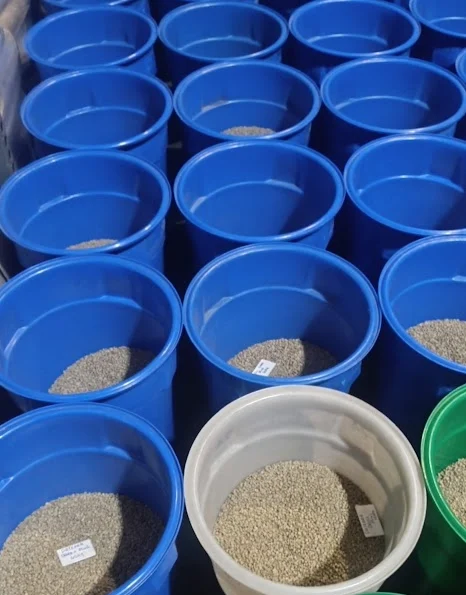
Raw green coffee beans in bins on the roast house floor, ready to be hand-roasted.
How the bean changes as the roast develops.
Roasting is applied heat over time, and the bean changes in a predictable order. Water drives off first. Then the sugars and amino acids in the bean start to brown, the Maillard reactions and caramelisation that build almost everything we recognise as coffee flavour. Acids that give a coffee its brightness are created and then broken down. The cell structure weakens, the bean swells, and aromatic oils migrate to the surface.
Two audible landmarks punctuate this. First crack is a sharp popping sound as steam pressure splits the bean. This is the point at which coffee becomes drinkable. Second crack is quieter and more brittle, the sound of the cell walls giving way, and it marks the beginning of dark roasting. Every roast level is defined by where you land relative to those two events, and by how long you spend getting there.
As a roast goes further: acidity falls, body and bitterness rise, origin character recedes and roast character advances. Nothing about that trade is automatically good or bad. It depends entirely on what the coffee is for.
The three bins, and the difference between them.
The lightest of the three is pulled shortly after first crack has finished. The bean is a matte, even mid-brown. In the cup it keeps the most of what Brazil gives you naturally: soft nuttiness, a mild sweetness like malt or unrefined sugar, low acidity and a rounded, gentle finish. It is a coffee that stays polite in a filter and does not fight anything you blend it with.
Brazil Dark Plus goes further, into the approach to second crack. The colour deepens, the surface starts to sheen, and the flavour shifts from nut towards cocoa and baked sugar. Acidity drops away almost entirely and the body thickens noticeably. This is the roast level that holds its shape under milk, which is why it does so much work in an espresso context.
Brazil Dark-Dark Plus is taken to the edge. Dark, glossy, unmistakably roasty on the nose before you grind it. Here the origin has largely stepped back and the roast is speaking: dark chocolate, treacle, a firm bittersweet finish, and the weight and crema-building power that a big espresso blend needs underneath everything else.
Why a recipe alone isn’t enough.
You can write down a target time and a target temperature for each of these three roasts. We do. But the roaster still has to earn the result on the day, because the inputs are never identical twice.
Green coffee is an agricultural product. Moisture content shifts across a crop year and across sacks. Bean density varies with altitude and processing. The ambient temperature and humidity in the roastery change what the drum has to do to hit the same curve. A batch following a hot batch behaves differently from the first of the morning. Charge a drum with the same weight of the same coffee on two different days and the same recipe will hand you two different coffees.
So the numbers are a guide, and the senses are the instrument. You listen for the pace of first crack, not just its arrival. You watch the colour move and the chaff come off. You smell the point where sweet turns to smoky — a shift measured in seconds, and the difference between a rich dark roast and a burnt one.
Get it wrong on the light side and the coffee tastes underdeveloped: grassy, thin, sour rather than bright. Get it wrong on the dark side and you flatten it, stripping out the sweetness you spent the whole roast building and leaving ash. The window that separates those two failures is narrow, and it moves.
Roasting for the blend, not for the bin.
The reason we hold the same Brazilian coffee at three different roast levels is that it is not one ingredient. It is three.
Blending is not simply mixing coffees together; it is deciding what each component contributes and roasting it specifically for that job. One version brings sweetness and smoothness. Another brings cocoa and body. Another brings depth, weight and a long finish. A blend built from three roast levels of one well-understood coffee has a coherence that a blend of three unrelated coffees struggles to reach — the parts already agree with each other.
That is what these bins are: components, cooling and resting, waiting to be weighed into blends such as Cinco Jalisco, Rising Tide, Bourbon Manizales, Jaggy Loko and High Segovia. What ends up in the bag is a set of decisions, made in small batches, by hand, by people who have made them thousands of times before.
Frequently asked questions
What is the difference between a medium, dark and very dark roast?
Roast level describes how far a coffee was taken relative to first and second crack. A medium roast is dropped after first crack and keeps more acidity, origin character and delicate sweetness. A dark roast approaches or enters second crack, trading acidity for body, cocoa notes and bitterness. A very dark roast is taken past that point, where roast character dominates and the cup becomes heavy, bittersweet and smoky.
Does a dark roast have more caffeine?
No. Caffeine is largely stable through roasting. Because darker beans lose more moisture and mass, a scoop measured by volume contains slightly less caffeine than the same scoop of a lighter roast. Measured by weight, the difference is negligible. Dark roasts taste stronger; that is bitterness and body, not caffeine.
Why would a roaster roast the same coffee to several different levels?
To use it as more than one ingredient. Roasting one green coffee to three levels produces three distinct flavour profiles that can be blended together, giving a roaster fine control over sweetness, body and finish while keeping the blend coherent.
Why does Brazilian coffee appear in so many espresso blends?
Brazilian coffees are typically low in acidity and high in nutty, chocolatey sweetness, with good body. That makes them a dependable base: they hold up under milk, they take a dark roast without turning harsh, and they give other components something to sit on.